

Buying guide
What a TV Costs to Run: Power Use, Standby, and Energy Labels
TV power consumption and running costs for 65-inch OLED and mini-LED TVs at the U.S. average electricity rate, plus picture modes, standby, and energy labels.
Going by the federal filings for the TVs we cover, a 65-inch TV costs about $33 to $75 a year to run. That assumes 5 hours a day and 18.31 cents per kilowatt-hour, the U.S. average residential electricity price for July 2026 from the Energy Information Administration. Most land between about $40 and $55. Next to what a TV costs to buy, that's small, so energy use rarely decides which TV to get. It matters more if a TV is on for much of the day, if you're buying a very big screen, or if you pay well above the average rate.
The power figures here come from public records, not our own measurements: the numbers manufacturers certify to the Department of Energy, which are also what the yellow FTC EnergyGuide label shows, plus ENERGY STAR's certified-product list and manufacturer spec sheets, all checked October 19, 2026. RTINGS measures typical and maximum power in its TV reviews, but it shows those figures only to members, so we use just the one RTINGS number printed in a review's text. Where we couldn't find a figure for a TV, we left it out rather than estimate one.
The three TVs below are the ones with the lowest yearly energy use in their groups. The Check price buttons are Amazon affiliate links: if you buy through one, we may earn a commission at no extra cost to you.
The short list
| # | Best for | TV | Est. price | |
|---|---|---|---|---|
| 01 | Lowest energy use of the 65-inch TVs we cover | 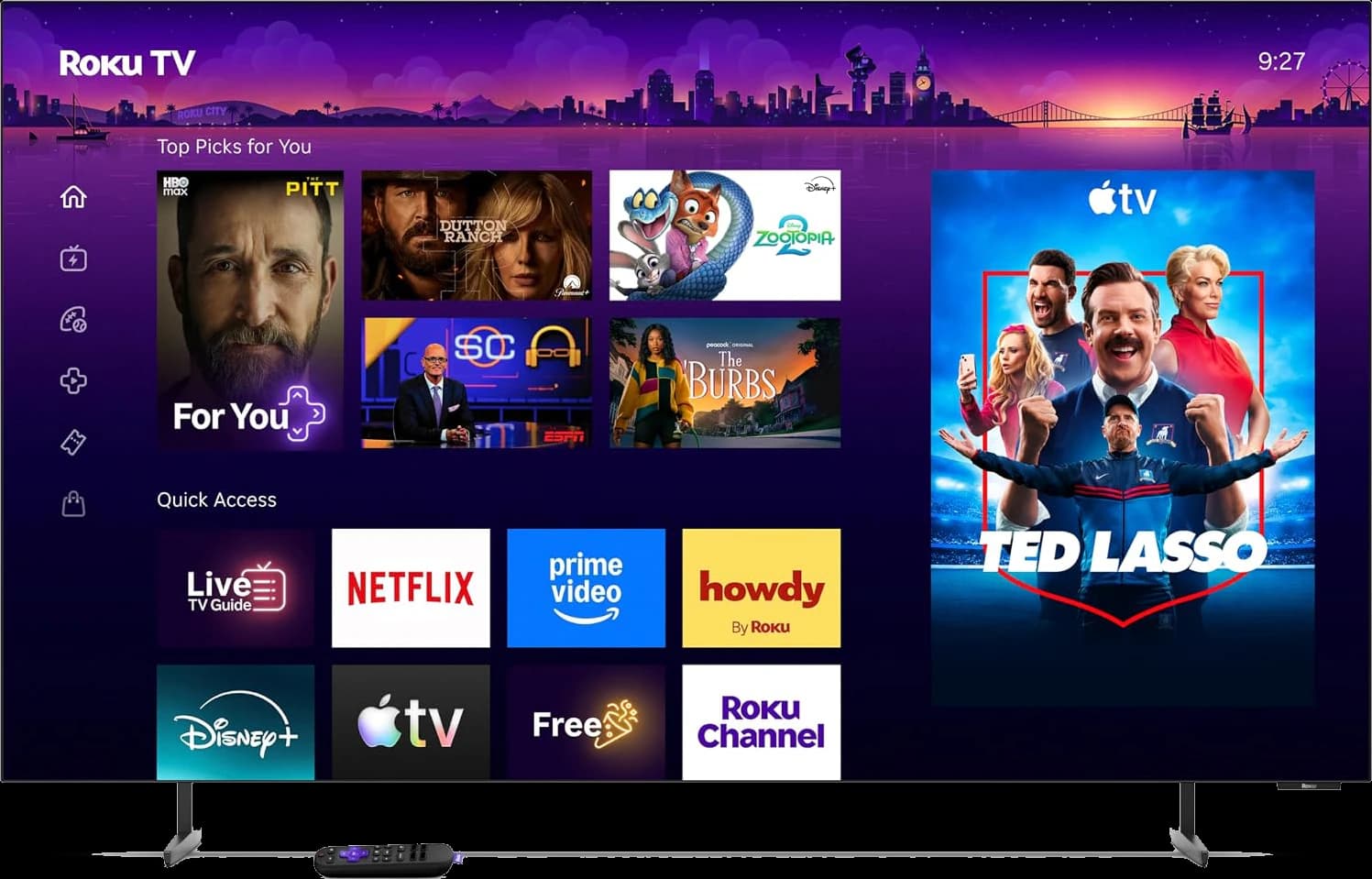 | OLED | ~$1,000 |
| 02 | Lowest energy use of the LG and Samsung OLEDs | 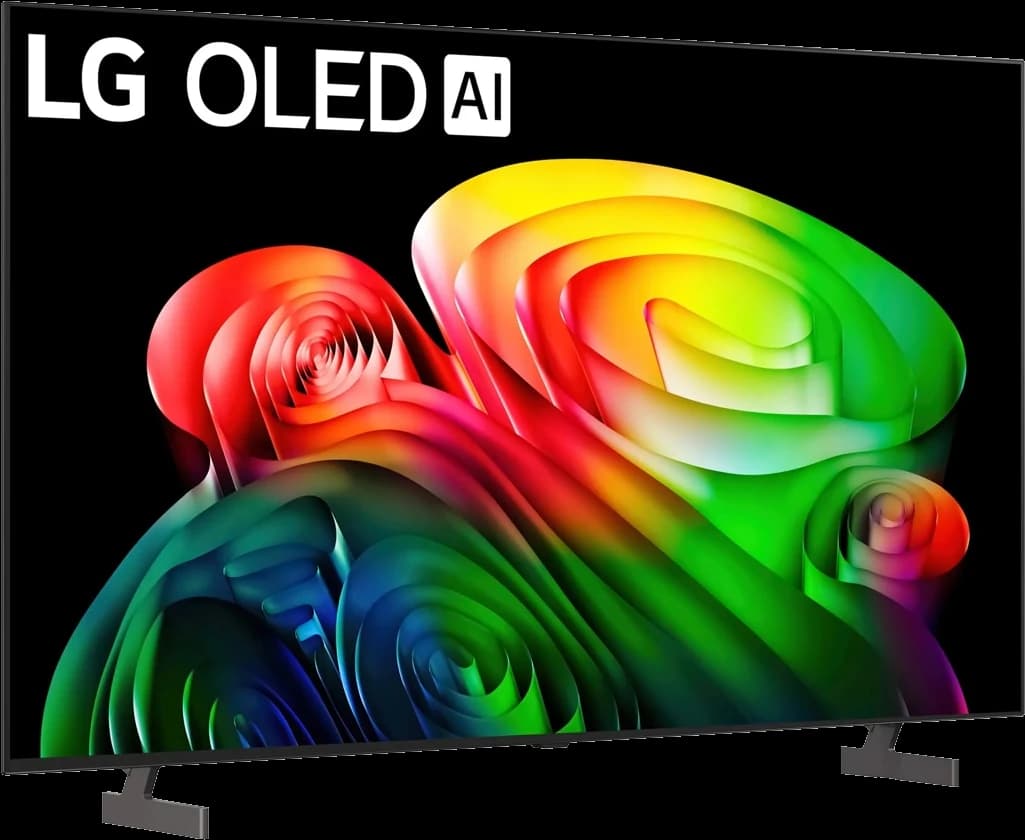 | OLED | ~$1,300 |
| 03 | Lowest energy use of the ENERGY STAR-certified TVs we cover | 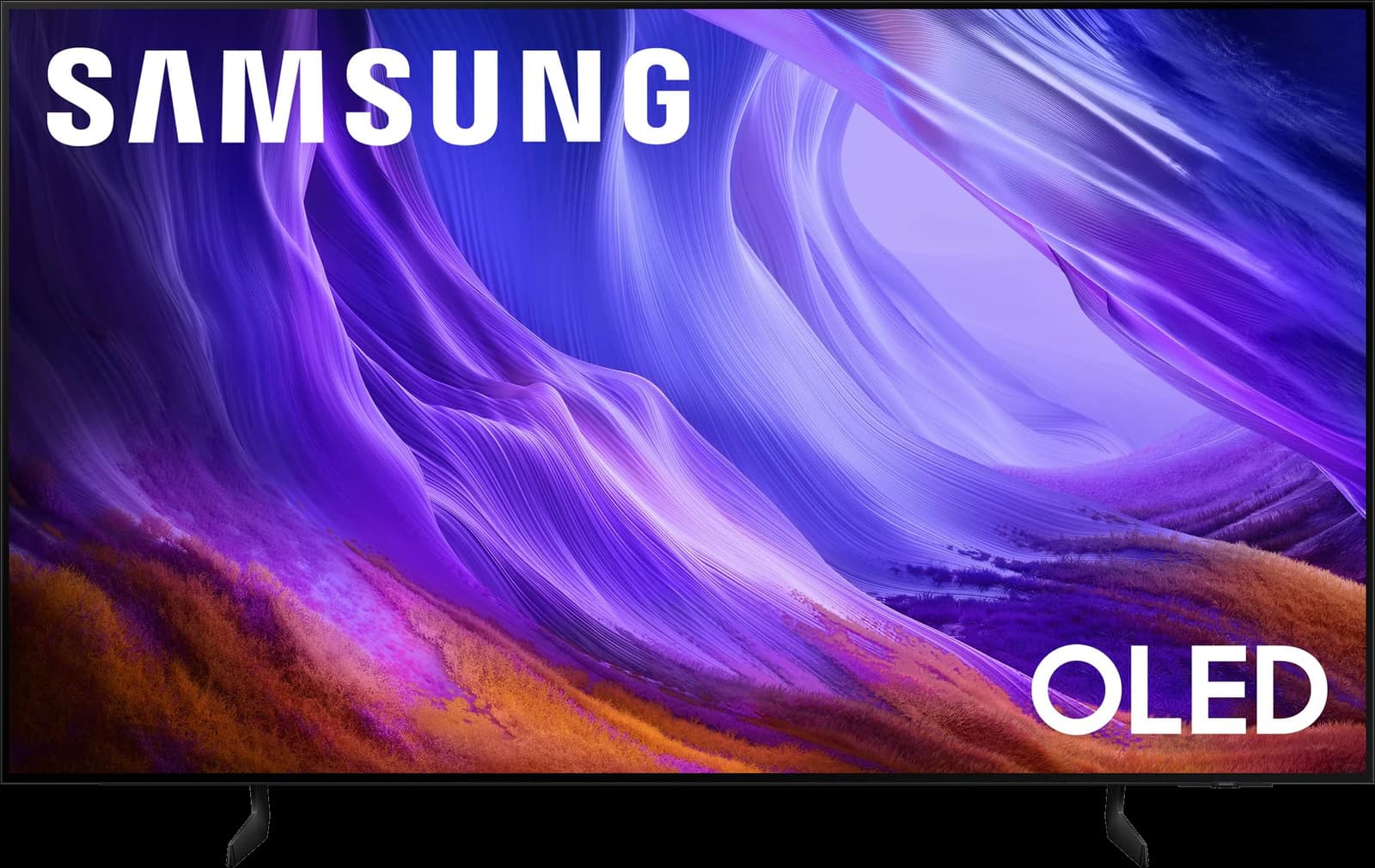 | OLED | ~$1,200 |
Prices are rough street-price estimates, not live quotes.
Ranked
Our picks
- 01
Lowest energy use of the 65-inch TVs we cover
Roku Pro Series OLED
- OLED
- 2026
- 55–65"
- ~$1,000
Roku's EnergyGuide label rates the 65-inch (65RAD5) at 179 kWh a year, about $33 at July's average rate. It's also dim, which suits a dark room: Tom's Guide measured 574 nits in HDR, against 1,365 for the LG C6. Roku's brighter Pro Series LX (65RCD5) is rated at 237 kWh, which fits the pattern that brightness costs power.
Highlights
- Highlight: Self-lit 4K OLED panel with perfect blacks for dark-room movies
- Highlight: Four HDMI 2.1 ports (one with eARC), 120Hz, VRR with FreeSync Premium, and automatic game mode
- Highlight: Dolby Vision and HDR10+, plus the simple, fast Roku OS
- Highlight: Sold through Amazon (the only store Roku's product page links to) and often discounted there
Trade-offs
- Trade-off: Modest peak brightness — reviewers put it roughly in the 500–650-nit class — so it struggles in bright rooms
- Trade-off: Only 55- and 65-inch sizes
- Trade-off: Picture processing trails the LG C6 and Samsung S90H
- Trade-off: The step-up Pro Series LX (55RCD5/65RCD5) is brighter, with up to 144Hz VRR, but costs more
More views
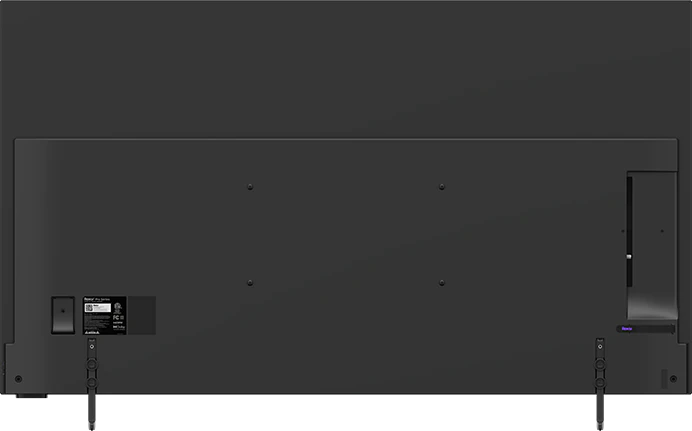
Images: Roku
- Bright room
- 2 out of 5
- Dark room
- 5 out of 5
- Movies
- 4 out of 5
- Sports
- 3 out of 5
- Gaming
- 5 out of 5
- Value
- 5 out of 5
Editorial fit scores, 1–5 — not lab measurements.
Check priceAffiliate link to Amazon.
- 02
Lowest energy use of the LG and Samsung OLEDs
LG B6 OLED
- OLED
- 2026
- 48–83"
- ~$1,300
LG's federal filing rates the 65-inch B6 at 122 watts while on and 225 kWh a year, about $41 at July's average and roughly $11 a year less than the C6. RTINGS rates it considerably below the C6, mainly because it's dimmer, so it suits a dim room. Unlike the C6 and G6, it isn't on ENERGY STAR's certified list.
Highlights
- Highlight: True OLED contrast at the lowest LG OLED price tier
- Highlight: Excellent for movies and dark-room viewing
- Highlight: Four HDMI 2.1 ports, all at the full 48Gbps bandwidth, with VRR
- Highlight: webOS with a familiar app lineup
Trade-offs
- Trade-off: Dimmer than the C6 and far behind bright mini-LEDs in daylight
- Trade-off: Lower peak brightness softens HDR highlights versus the C and G series
- Trade-off: Not the pick for a sunny family room
- Bright room
- 2 out of 5
- Dark room
- 5 out of 5
- Movies
- 5 out of 5
- Sports
- 3 out of 5
- Gaming
- 4 out of 5
- Value
- 5 out of 5
Editorial fit scores, 1–5 — not lab measurements.
Check priceAffiliate link to Amazon.
- 03
Lowest energy use of the ENERGY STAR-certified TVs we cover
Samsung S85H OLED
- OLED
- 2026
- 48–83"
- ~$1,200
Samsung's federal filing rates the 65-inch S85H at 133 watts and 253 kWh a year, about $46 at July's average, and ENERGY STAR lists it as certified. RTINGS rates it slightly behind the LG B6, its reflection handling is limited, and like every Samsung TV it has no Dolby Vision.
Highlights
- Highlight: Real OLED contrast at a lower Samsung price point
- Highlight: Solid gaming feature set for consoles
- Highlight: Tizen smart platform with free Samsung TV Plus channels
Trade-offs
- Trade-off: Dimmer and less refined than the S90H / S95H
- Trade-off: No Dolby Vision
- Trade-off: Skips some of the glare-free and processor upgrades of higher tiers
- Bright room
- 3 out of 5
- Dark room
- 5 out of 5
- Movies
- 4 out of 5
- Sports
- 3 out of 5
- Gaming
- 4 out of 5
- Value
- 5 out of 5
Editorial fit scores, 1–5 — not lab measurements.
Check priceAffiliate link to Amazon.
How to work out what a TV costs to run
The formula is short: watts × hours per day × 365 ÷ 1,000 gives kilowatt-hours (kWh) per year, and kWh × your price per kWh gives dollars. Here it is for the 65-inch LG C6, one of the TVs we recommend most, using the 155 watts LG certifies for it in on mode:
- Power: 155 watts while on, from LG's filing with the Department of Energy.
- Hours: 5 a day. That's an assumption, and it's the same one the FTC's EnergyGuide label uses (5 hours on, 19 in standby). For comparison, the Bureau of Labor Statistics found that Americans 15 and older spent an average of 2.6 hours a day watching TV in 2025. A TV is often on when nobody's really watching, and households vary a lot.
- Energy: 155 × 5 × 365 ÷ 1,000 = 282.9 kWh a year.
- Price: 18.31 cents per kWh, the U.S. average residential price for July 2026 in EIA's Electric Power Monthly, released September 24, 2026.
- Cost: 282.9 × $0.1831 = $51.79 a year while on. Standby adds 0.4 watts × 19 hours × 365 ÷ 1,000 = 2.8 kWh, or about 51 cents, for roughly $52 in all.
What the 65-inch TVs we cover cost to run
Every row below is a 65-inch model, so the comparison is like for like. The watts and kWh are the figures each manufacturer certified to the Department of Energy, the basis of its EnergyGuide label. The yearly cost is our math at July's 18.31-cent average.
From the cheapest to run to the most expensive is about $42 a year, and most of these TVs land within a few dollars of each other. The Sony Bravia 8 II sits near the bottom mainly because of its standby power, explained below. The Bravia 5 has both the highest on-mode rating in the table and high standby.
| TV (65-inch model) | On mode | Standby | Per year | Cost at 18.31¢ | ENERGY STAR |
|---|---|---|---|---|---|
| Roku Pro Series OLED (65RAD5) | 96.4 W | 0.42 W | 179 kWh | $33 | No |
| LG B6 OLED (OLED65B6GUA) | 122 W | 0.4 W | 225 kWh | $41 | No |
| Samsung S85H OLED (QN65S85HAE) | 133 W | 1.5 W | 253 kWh | $46 | Yes |
| LG G6 OLED (OLED65G6WUA) | 144 W | 0.4 W | 266 kWh | $49 | Yes |
| Samsung S90H OLED (QN65S90HAE) | 141 W | 1.5 W | 268 kWh | $49 | Yes |
| Samsung S95H OLED (QN65S95HAF) | 145 W | 1.5 W | 275 kWh | $50 | Yes |
| Sony Bravia 9 II (K‑65XR90M2) | 145 W | 2.0 W | 279 kWh | $51 | No |
| Hisense U7SG (65U7SG) | 149 W | 2.0 W | 285 kWh | $52 | No |
| LG C6 OLED (OLED65C6PUA) | 155 W | 0.4 W | 286 kWh | $52 | Yes |
| Hisense U8QG (65U8QG) | – | – | 287 kWh | $53 | No |
| Sony Bravia 8 II (K‑65XR80M2) | 129 W | 14.7 W | 338 kWh | $62 | No |
| Sony Bravia 5 (K‑65XR50) | 175 W | 12.7 W | 407 kWh | $75 | No |
Watts and kWh: manufacturers' certified figures in the DOE Compliance Certification Database (data dated October 9, 2026), which assume 5 hours on and 19 in standby a day; they match the EnergyGuide labels we checked. Hisense U8QG: kWh from its EnergyGuide label, since we found no DOE record with its watts. Yearly cost: our math at EIA's July 2026 U.S. residential average. ENERGY STAR: its certified-TV list, updated October 18, 2026. Not shown: the TCL QM8L and QM7L, which had no EnergyGuide figure or DOE record we could find.
Your hours and your rate matter more than the model
The gap between models is small next to the gap between households. At July's average rate, the 65-inch C6's on-mode power costs about $27 a year at 2.6 hours a day, $52 at 5 hours, and $83 at 8 hours.
Electricity prices vary even more. In EIA's July 2026 table, the average residential price ran from 12.72 cents per kWh in Louisiana to 48.00 cents in Hawaii, with California at 33.61 cents. At those rates, the C6's 286 kWh a year costs about $36 in Louisiana, $96 in California, and $137 in Hawaii. July is a summer month, too: EIA's U.S. average for the first seven months of 2026 was 18.19 cents, and for the 12 months through July, 17.99 cents.
To use your own rate, look for the price per kWh on your electric bill; if the bill splits supply and delivery charges, add the two. Then multiply it by the kWh on the TV's EnergyGuide label.
OLED vs mini-LED vs LCD: which uses more power?
It depends on the TV more than the technology. An LCD, including every mini-LED, makes its picture by shining a backlight through the panel, and RTINGS calls the backlight "by far the biggest drain" on a TV's power. An OLED has no backlight. Each pixel makes its own light, so its draw rises and falls with how bright the picture is.
RTINGS' testing of 2020 and 2021 TVs found OLEDs among the most power-hungry in SDR at its calibrated settings, while the brightest LED TVs drew the most at maximum brightness in HDR. ENERGY STAR's consumer page says the opposite, that "OLEDs also use less energy than LCD screens," though that page's buying advice is dated: it still notes that "as of 2019, an 8K TV is very expensive."
The 2026 federal figures show why neither rule of thumb holds up. At 65 inches, the OLEDs in the table above are rated at 96 to 155 watts and the mini-LEDs at 145 to 175 watts. The Sony Bravia 9 II, an RGB mini-LED that RTINGS credits with incredibly high peak brightness, is rated at 145 watts, less than the LG C6's 155. The Hisense U7SG, also a bright mini-LED, is rated at 285 kWh a year to the C6's 286. Panel generation matters as well: LG rates the 65-inch G6, which it calls its brightest OLED ever, at 144 watts, below the C6. Compare the label for the exact model, not the panel type.
Picture modes, brightness, and HDR
Brightness is the biggest lever you control. RTINGS found that power consumption "almost perfectly scales with brightness," though halving the brightness setting doesn't halve the draw, because the rest of the TV uses power too. A vivid or dynamic preset that pushes brightness up costs more to run than a dimmer, more accurate one. HDR gets its own treatment: RTINGS measures each TV's maximum draw in HDR at full brightness, and the EU label lists HDR consumption separately because, in the regulation's words, HDR "may lead to a different energy use."
The U.S. label already blends modes. Since DOE updated its TV test in 2023, the on-mode figure behind an EnergyGuide label is the average of three presets: the out-of-box SDR default, the brightest SDR preset, and the default HDR10 preset. ENERGY STAR sets its limits on the same three presets. A label reflects a mix of uses, not your settings.
Spec-sheet maximums show the ceiling. Samsung lists the 65-inch S90H at 141 watts typical, the same as its DOE figure, and 375 watts maximum, and the 65-inch S95H at 145 and 600 watts. Samsung doesn't say how it measures the maximum, so treat it as a limit rather than a typical draw. Even if an S90H ran at its full 375 watts for 5 hours every day, which normal shows won't do, that would be about 684 kWh, or $125 a year at July's average. RTINGS' Hisense U8 review says the 65-inch it tested "consumes a maximum of 208W."
Standby power
Standby is usually a rounding error, but not always. ENERGY STAR's TV spec caps standby at 0.5 watts, or 1 watt for a TV that stays connected to a network. DOE's test measures standby with the TV connected to the internet and to other devices on a home network, and the EnergyGuide math counts 19 hours of it a day.
Most of the TVs we cover file well under 2 watts: 0.4 watts for the LG OLEDs, 0.42 for the Roku, 1.5 for the Samsungs (Samsung's spec sheets say 0.5), and 2.0 for the Hisense U7SG and Sony Bravia 9 II. Sony's filings for the 65-inch Bravia 8 II and Bravia 5 list 14.7 and 12.7 watts. For the Bravia 8 II, that's about 102 kWh a year, roughly 30 percent of its label total and about $19 at July's average.
RTINGS notes that many TVs have a quick-start feature that keeps them in standby, ready to turn on fast, instead of shutting down fully. Turning it off can trim standby use, and some TVs also shut down completely if you hold the remote's power button.
ENERGY STAR and 2026 TVs
ENERGY STAR still certifies TVs. Its partner page lists Version 9.1 as the current television specification and says no new versions are in development. Version 9 took effect on October 20, 2022, and Version 9.1, finalized March 6, 2024, moved testing to DOE's updated procedure. ENERGY STAR says certified TVs are, on average, about 34% more energy efficient than conventional models.
Its certified-TV list for the same models shows lower on-mode figures than their EnergyGuide labels: 141.6 watts and 261 kWh a year for the 65-inch C6, against 155 watts and 286 kWh. Both come from the federal test procedure, but DOE lets a manufacturer state a figure at or above what its test units measured, so a label can be conservative. We use the label figures because they're what you'll see when you shop, and they cover more brands.
The list, updated October 18, 2026, has 184 entries. These 2026 TVs we cover are on it:
- LG C6: 42, 48, 55, and 65 inches, plus the 77- and 83-inch C6H.
- LG G6: 55, 65, 77, and 83 inches.
- Samsung S90H: 42, 48, 55, 65, and 77 inches.
- Samsung S95H: 55, 65, 77, and 83 inches.
- Samsung S85H: 48, 55, 65, 77, and 83 inches.
- Not listed: the LG B6, and no Sony, TCL, Hisense, Roku, or Amazon TV. TCL's own QM7L and QM8L pages say "Energy Star: No."
How to read EnergyGuide labels, spec sheets, and EU labels
Three kinds of power figures show up when you shop:
- EnergyGuide, the yellow U.S. label: an estimated yearly cost at 16 cents per kWh and 5 hours a day, the model's kWh per year, and where it falls in a cost range for similar sizes ($27 to $110 for 65 to 69 inches). The FTC requires it on TVs and requires manufacturers to post it online. Multiply the kWh by your own rate. At July's 18.31-cent average, the real cost is about 14% higher than the label's.
- Spec sheets: check whether a number is typical or maximum. Samsung lists both, and its maximums run two to four times its typical figures. TCL lists a single "Power Consumption" of 350 watts for the 65-inch QM7L, with its EnergyGuide marked "TBD," and doesn't say which it is. Don't multiply a figure like that by your hours; wait for the EnergyGuide number.
- EU energy label: TVs sold in the EU carry a label under Regulation (EU) 2019/2013, in use since March 1, 2021. It grades efficiency from A to G, with separate classes and consumption figures for SDR and HDR, in kWh per 1,000 hours. That unit works out to the TV's average watts, so 90 kWh/1000h means about 90 watts. EU models carry different model numbers from U.S. ones, so an EU label doesn't tell you exactly what the U.S. version draws.
How to cut what your TV costs to run
Each of these trims a little off the yearly figure:
- Turn down the brightness, or the backlight on an LCD, especially at night. RTINGS calls the backlight the biggest drain on power.
- Turn on the light sensor, often called automatic brightness control. ENERGY STAR says it saves energy by matching brightness to the room.
- Use the sleep timer if you tend to fall asleep with the TV on, as RTINGS suggests.
- Turn off quick start if you don't need the TV to wake instantly.
- Stream with the TV's own apps rather than a game console. ENERGY STAR calls a smart TV "the most efficient way to stream."
- Mind the size: Samsung rates the S90H at 141 watts at 65 inches and 181 at 77, and LG rates the C6 at 119 watts at 55 inches and 155 at 65.
Sources
Records, reviews, and specs this guide draws on, checked October 19, 2026:
- U.S. Energy Information Administration, Electric Power Monthly, Tables 5.6.A and 5.3 (July 2026 data, released September 24, 2026): eia.gov/electricity/monthly
- U.S. Department of Energy, Compliance Certification Database, Television Sets (data dated October 9, 2026): regulations.doe.gov/certification-data
- FTC EnergyGuide labels for the LG C6, Samsung S90H, Sony Bravia 8 II and Bravia 5, Hisense U7SG and U8QG, and Roku Pro Series OLED, as shown on their Amazon listings; label rules in 16 CFR 305.25: ecfr.gov
- DOE television test procedure (10 CFR 430, appendix H, and the March 15, 2023 final rule) and represented-value rules (10 CFR 429.25): ecfr.gov, federalregister.gov
- ENERGY STAR televisions pages, Version 9.1 specification and key product criteria, and certified-TV list: energystar.gov/products/televisions, data.energystar.gov
- Samsung US spec sheets for the S90H, S95H, and S85H: samsung.com/us
- TCL QM7L and QM8L product pages: us.tcl.com
- RTINGS, "OLED and LED TV Power Consumption and Electricity Cost" (updated September 29, 2021), and its reviews of the Hisense U8, LG B6, Samsung S85H, and Sony Bravia 9 II: rtings.com
- Tom's Guide, Roku Pro Series OLED review (October 8, 2026): tomsguide.com
- Commission Delegated Regulation (EU) 2019/2013 on energy labelling of electronic displays: eur-lex.europa.eu
- U.S. Bureau of Labor Statistics, American Time Use Survey, 2025 results (June 25, 2026): bls.gov/tus
Frequently asked questions
How much does it cost to run a TV for a year?
For the 65-inch TVs we cover, about $33 to $75 a year at 5 hours a day and July 2026's U.S. average rate of 18.31 cents per kWh, with most between about $40 and $55. For your own number, multiply the kWh on the TV's EnergyGuide label by your electricity rate.
How much electricity does a TV use per hour?
The 65-inch LG C6 is certified at 155 watts while on, or 0.155 kWh an hour, which costs about 2.8 cents at July 2026's 18.31-cent average. A brighter picture uses more and a dimmer one less.
Do OLED TVs use more electricity than mini-LED TVs?
Not as a rule. At 65 inches, the 2026 OLEDs we cover are rated at 96 to 155 watts in their federal filings and the mini-LEDs at 145 to 175 watts, and the bright Hisense U7SG mini-LED is rated within 1 kWh a year of the LG C6 OLED. Check the label for the exact model.
Does HDR use more power than SDR?
It can, because HDR drives highlights brighter and brightness is what costs power. The EU label lists SDR and HDR consumption separately, and RTINGS measures a TV's maximum draw in HDR at full brightness. The U.S. EnergyGuide figure averages the default SDR, brightest SDR, and default HDR10 presets.
How much power does a TV use when it's off?
Most TVs we cover file 0.4 to 2 watts in standby, which comes to under $3 a year. Sony's filings for the 65-inch Bravia 8 II and Bravia 5 are the exceptions, at 14.7 and 12.7 watts, adding roughly $16 to $19 a year at July 2026's average rate.
Are any 2026 TVs ENERGY STAR certified?
Yes. ENERGY STAR's list, updated October 18, 2026, includes the LG C6 (with the C6H) and G6 and Samsung's S90H, S95H, and S85H in most sizes. The LG B6 and the Sony, TCL, Hisense, and Roku TVs we cover aren't on it.
Related guides
Disclosure: Our picks are independent and editorial — a synthesis of public reviews and specs, not our own lab measurements. We may earn a commission from qualifying purchases made through links on this page, at no extra cost to you.